The Umayyad Caliphate
From Wikipedia: Umayyad Caliphate
From the Deenlume library, adapted from Wikipedia
Awaiting review by a scholar. Please read with care and check the sources.
The Umayyad Caliphate, or the Umayyad Empire (US: ; Arabic: ٱلْخِلَافَة ٱلْأُمَوِيَّة, romanized: al-Khilāfa al-Umawiyya), was the second Islamic caliphate, ruled by the Umayyad dynasty from 661 to 750. It succeeded the Rashidun Caliphate, whose third caliph, Uthman ibn Affan (r. 644–656), was also a member of the Umayyad clan. The Umayyad family established hereditary rule under Mu'awiya ibn Abi Sufyan, the long-time governor of Syria, who became caliph in 661 after emerging victorious in the First Fitna. Syria served as the caliphate's metropolitan province thereafter, with Damascus as its capital.
Umayyad authority was later challenged in the Second Fitna, during which the Sufyanid line of Mu'awiya (which includes only the first three Umayyad caliphs) was replaced in 684 by Marwan ibn al-Hakam, who founded the Marwanid line that became the ruling Umayyad house henceforth. His eldest son and successor Abd al-Malik ibn Marwan restored Umayyad control over the Caliphate after defeating the Zubayrids in 692. Abd al-Malik made key reforms to the administrative structure of the caliphate, including the centralization of caliphal power, the restructuring of the military, and policies of Arabization and Islamization within the bureaucracy.
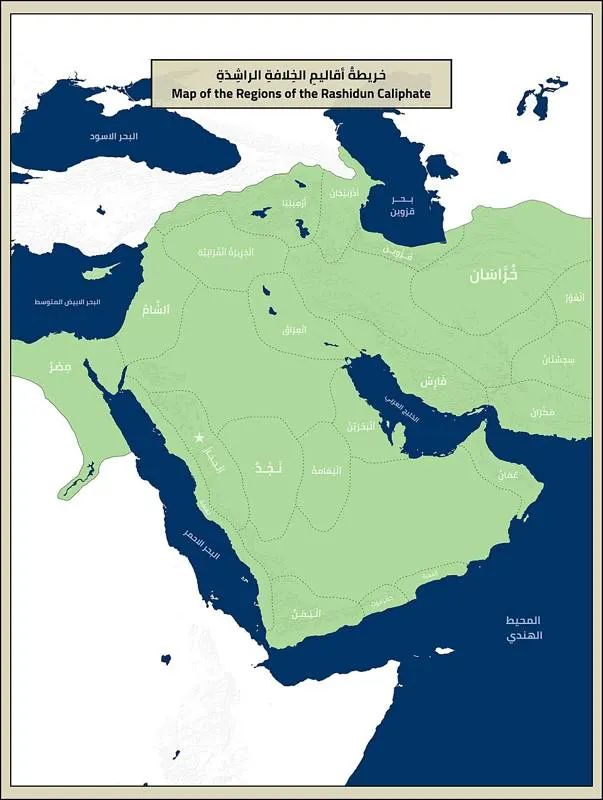
The Umayyads advanced the early Muslim conquests, conquering the Maghreb, the Iberian Peninsula, Central Asia and Sindh. At its greatest extent, the Umayyad Caliphate covered an area of 11,000,000–15,000,000 km2 (4,300,000–5,790,000 sq mi), making it one of the largest empires in history. However, the constant warfare exhausted the caliphate's resources, while revolts and tribal rivalries weakened it from within. In 750, the Abbasids overthrew Caliph Marwan II, and most of the Umayyad family were slain. But in 756, Abd al-Rahman I, a grandson of Caliph Hisham ibn Abd al-Malik, established an independent state in al-Andalus with its capital at Córdoba, which became a major center of science, medicine, philosophy and invention during the Islamic Golden Age.
The Umayyads ruled over a vast multiethnic and multicultural population. Christians, who still constituted a majority of the caliphate's population, and Jews were allowed to practice their own religion in exchange for the payment of jizya, from which Muslims were exempt. Muslims were required to pay the zakat, which was explicitly collected for the purposes of charity and for the benefit of Muslims or Muslim converts. Under the early Umayyad caliphs, prominent administrative positions were held by Christians, some of whom belonged to families that had served under the Byzantines. The employment of Christians was part of a broader policy of religious toleration that was necessitated by the presence of large Christian populations in the conquered provinces, including in their heartland of Syria. This policy also helped to increase Mu'awiya's popularity and solidified Syria as his power base. The Umayyad era is often considered the formative period of Islamic art and architecture.
Early influence
During the pre-Islamic period, the Banu Umayya were a leading clan of the Quraysh tribe of Mecca. By the end of the 6th century, the Umayyads dominated the Quraysh's increasingly prosperous trade networks with Syria and developed economic and military alliances with the nomadic Arab tribes that controlled the northern and central Arabian desert expanses, affording the clan a degree of political power in the region. The Umayyads under the leadership of Abu Sufyan ibn Harb were the principal leaders of Meccan opposition to the Islamic prophet Muhammad, but after the latter captured Mecca in 630, Abu Sufyan and the Quraysh embraced Islam. To reconcile his influential Qurayshi tribesmen, Muhammad gave his former opponents, including Abu Sufyan, a stake in the new order. Abu Sufyan and the Umayyads relocated to Medina, the political centre of Islam, to maintain their new-found political influence in the nascent Muslim community.
Muhammad's death in 632 left open the succession of leadership of the Muslim community. Leaders of the Ansar, the natives of Medina who had provided Muhammad safe haven after his emigration from Mecca in 622, discussed forwarding their own candidate out of concern that the Muhajirun, Muhammad's early followers and fellow emigrants from Mecca, would ally with their fellow tribesmen from the former Qurayshi elite and take control of the Muslim state. The Muhajirun gave allegiance to one of their own, the early, elderly companion of Muhammad, Abu Bakr (r. 632–634), and put an end to Ansarite deliberations. Abu Bakr was viewed as acceptable by the Ansar and the Qurayshi elite and was acknowledged as caliph (leader of the Muslim community). He showed favor to the Umayyads by awarding them command roles in the Muslim conquest of Syria. The appointees included Yazid and Mu'awiya, the sons of Abu Sufyan, who owned property and maintained trade networks in Syria.
Abu Bakr's successor Umar (r. 634–644) curtailed the influence of the Qurayshi elite in favor of Muhammad's earlier supporters in the administration and military, but nonetheless allowed the growing foothold of Abu Sufyan's sons in Syria, which was all but conquered by 638. When Umar's overall steward of the province, Abu Ubayda ibn al-Jarrah, died in 639, he appointed Yazid as governor of the districts of Damascus, Palestine and Jordan. Yazid died shortly after and Umar appointed Yazid's brother Mu'awiya in his place. Umar's exceptional treatment of Abu Sufyan's sons may have stemmed from his respect for the family, their burgeoning alliance with the powerful Banu Kalb tribe as a counterbalance to the influential Himyarite settlers in Homs who viewed themselves as equals to the Quraysh in nobility, or the lack of a suitable candidate at the time, particularly amid the plague of Amwas which had already killed Abu Ubayda and Yazid. Under Mu'awiya's stewardship, Syria remained domestically peaceful, well-organized and securely defended from its former Byzantine rulers.
Caliphate of Uthman
Umar's successor, Uthman ibn Affan, was a wealthy Umayyad and early Muslim convert with marital ties to Muhammad. He was elected by the shura council, composed of Muhammad's cousin Ali ibn Abi Talib, Zubayr ibn al-Awwam, Talha ibn Ubayd Allah, Sa'd ibn Abi Waqqas and Abd al-Rahman ibn Awf, all of whom were close, early companions of Muhammad and belonged to the Quraysh. He was chosen over Ali because he would ensure the concentration of state power into the hands of the Quraysh, as opposed to Ali's determination to diffuse power among all of the Muslim factions. From early in his reign, Uthman displayed explicit favoritism to his kinsmen, in stark contrast to his predecessors. He appointed his relatives as governors over the conquered regions, namely much of the Sasanian Empire, i.e. Iraq and Iran, and the former Byzantine territories of Syria and Egypt. In Medina, he relied extensively on the counsel of his Umayyad cousins, the brothers al-Harith and Marwan ibn al-Hakam. According to the historian Wilferd Madelung, this policy stemmed from Uthman's "conviction that the house of Umayya, as the core clan of Quraysh, was uniquely qualified to rule in the name of Islam".
Uthman's nepotism provoked the ire of the Ansar and the members of the shura. In 645/46, he added the Jazira (Upper Mesopotamia) to Mu'awiya's Syrian governorship and granted the latter's request to take possession of all Byzantine crown lands in Syria to help pay his troops. He had the surplus taxes from the wealthy provinces of Kufa and Egypt forwarded to the treasury in Medina, which he used at his personal disposal, frequently disbursing its funds and war booty to his family members. Moreover, the lucrative Sasanian crown lands of Iraq, which Umar had designated as communal property for the benefit of the Arab garrison towns of Kufa and Basra, were turned into caliphal crown lands to be used at Uthman's discretion. Mounting resentment against Uthman's rule in Iraq and Egypt and among the Ansar and Quraysh of Medina culminated in the killing of the caliph in 656. In the assessment of the historian Hugh N. Kennedy, Uthman was killed because of his determination to centralize control over the caliphate's government by the traditional elite of the Quraysh, particularly his Umayyad clan, which he believed possessed the "experience and ability" to govern, at the expense of the interests, rights and privileges of many early Muslims.
References
Text adapted from Umayyad Caliphate on Wikipedia (revision 1386461591), licensed CC BY-SA 4.0.