The Abbasid Caliphate
From Wikipedia: Abbasid Caliphate
From the Deenlume library, adapted from Wikipedia
Awaiting review by a scholar. Please read with care and check the sources.
The Abbasid Caliphate or Abbasid Empire was the third Islamic caliphate, ruled by the Abbasid dynasty. The dynasty was descended from Muhammad's uncle, Abbas ibn Abd al-Muttalib (d. 653), after whom it is named. The Abbasids rose to power in 750, when the Abbasid revolution overthrew the preceding Umayyad Caliphate. They ruled as caliphs from their base in Iraq until 1258, with Baghdad as their capital for most of their history.
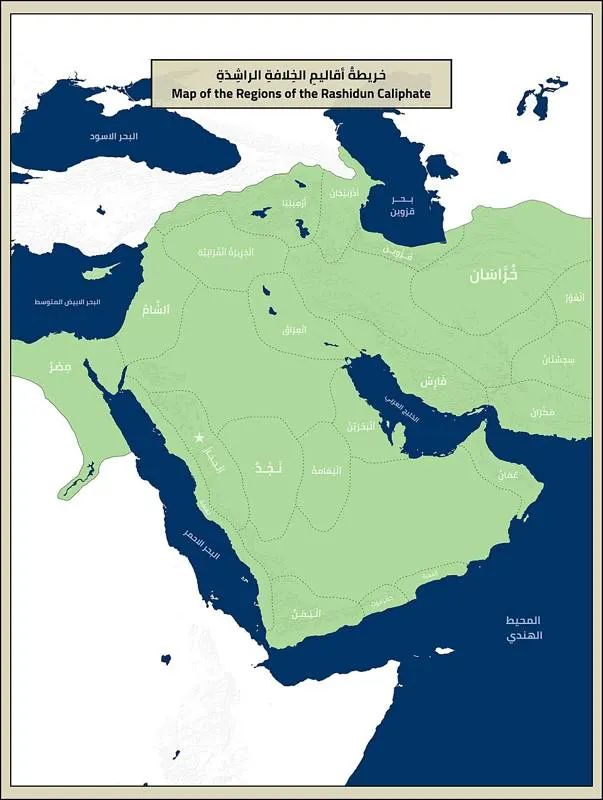
The Abbasid Revolution had its origins and first successes in the easterly region of Khurasan, far from the Syrian center of Umayyad influence. The Abbasids first centered their government in Kufa, Iraq, but in 762 the second caliph al-Mansur founded the city of Baghdad and made it the capital. Baghdad became a center of science, culture, arts, and invention, ushering in what became known as the Golden Age of Islam. It hosted several key academic institutions, such as the House of Wisdom, as well as a multi-ethnic and multi-religious population, which made the city famous as a centre of learning across the world. The Abbasid period was marked by the use of bureaucrats in government, including the vizier, as well as a growing inclusion of non-Arab Muslims in the ummah (Muslim community) and among the political elites.
The height of Abbasid power and prestige is traditionally associated with the reign of Harun al-Rashid (r. 786–809). After his death, a civil war brought new divisions and was followed by significant changes to the character of the state, including the creation of a new professional army recruited mainly from Turkic slaves and the construction of a new capital, Samarra, in 836. The 9th century also saw many provinces becoming increasingly autonomous, giving rise to local dynasties that controlled different regions of the empire, such as the Aghlabids, Tahirids, Samanids, Saffarids, and Tulunids. After a period of turmoil in the 860s, the caliphate regained some stability and its seat returned to Baghdad in 892.
During the 10th century, the caliphs were reduced to mere figureheads, with real political and military power resting in the hands of the Iranian Buyids and the Seljuq Turks, who took control of Baghdad in 945 and 1055, respectively. The Abbasids eventually regained control of Iraq during the reign of Caliph al-Muqtafi (r. 1136–1160) and extended their rule into Iran during the reign of Caliph al-Nasir (r. 1180–1225). This revival ended in 1258 with the sack of Baghdad by the Mongols under Hulagu Khan and the execution of Caliph al-Musta'sim, marking the effective end of the Abbasid Caliphate. A surviving branch of the Abbasid dynasty was formally reinstated in 1261 by the Mamluk sultans in Cairo, but it lacked any political power. The dynasty continued to claim symbolic authority until the Ottoman conquest of Egypt in 1517, the last Abbasid caliph being al-Mutawakkil III.
Abbasid Revolution (747–750)
The Abbasid caliphs descended from Abbas ibn Abd al-Muttalib, one of the youngest uncles of Muhammad and of the same Banu Hashim clan. This family relation to Muhammad made them appealing to those who were discontented with the rule of the Umayyad caliphs (661–750), who did not descend from the same family. Over the course of their rule, the Umayyads suppressed several rebellions that attempted to bring other members of Muhammad's family to power.
One of the claims that the Abbasids made in the early years of their political movement was that Abu Hashim, the son of Muhammad ibn al-Hanafiyya and grandson of Ali, had formally transferred the Imamate (imāmah) to Muhammad ibn Ali (the great-grandson of Abbas) and thus to the Abbasid family. Muhammad ibn Ali began to campaign in Persia for the return of power to the family of Muhammad, the Hashemites, starting in 718 during the reign of Umar ibn Abd al-Aziz. Later, after they had attained power and needed to broaden their support among Muslims, the Abbasids supplemented this claim with other claims to justify their legitimacy.
The Abbasids also distinguished themselves from the Umayyads by attacking their moral character and administration in general. The Abbasids also appealed to non-Arab Muslims, known as mawali, who remained outside the kinship-based society of the Arabs and were perceived as a lower class within the Umayyad empire.
The eventual launching point of the revolution was Khurasan (roughly northeastern Iran), a strategic province that was distant from the caliphate's centres of power and had enjoyed a degree of autonomy and local identity since the pre-Islamic Sasanian period. Despite being on the frontier of the Islamic world, it encompassed a relatively large Muslim population made up of both Arab settlers and local converts who were relatively well-integrated with each other. The population resented Umayyad rule, which was seen as foreign and oppressive, and local tensions had simmered for years. According to Ira Lapidus, "The Abbasid revolt was supported largely by Arabs, mainly the aggrieved settlers of Merv with the addition of the Yemeni faction and their Mawali".
Support for the Abbasids spread through Khurasan during the 740s. In 744 or 745, some of its local leaders, including Qahtaba ibn Shabib, traveled to Mecca for the hajj pilgrimage and met there with the head of the Abbasid family, Ibrahim al-Imam (fourth in descent from Abbas). They pledged allegiance to Ibrahim and returned to Khurasan accompanied by one of Ibrahim's freedmen, a Persian known as Abu Muslim.
During the reign of the Umayyad caliph Marwan II, this opposition culminated in a rebellion that began on 9 June 747 (15 Ramadan 129 AH). Abu Muslim, rising from Khurasan, initiated an open revolt against Umayyad rule. Close to 10,000 soldiers were under Abu Muslim's command when the hostilities officially began in Merv. The rebellion's main initial support came from Khurasan, despite the opposition of the local Umayyad governor there, Nasr ibn Sayyar, as well as from Shi'i Arabs. Qahtaba, now one of Abu Muslim's generals, defeated Nasr ibn Sayyar and pursued him west, where he defeated the Umayyads at the Battle of Gorgan, the Battle of Nahavand and finally in the Battle of Karbala, all in the year 748.
Ibrahim had remained in Humayma (in present-day Jordan) and his identity was not revealed to most of the movement's supporters, who knew only that they supported someone from the family of Muhammad to replace the Umayyads. When Marwan learned of the Abbasid involvement in the uprising, he had Ibrahim arrested and thrown into prison, where he died or was executed in 749. The rebels pressed on to capture the important city of Kufa in Iraq that same year, although Qahtaba died on the way. To pre-empt any attempt by the Alids (those descended from Muhammad's cousin and son-in-law, Ali) to put forth their own candidate for the caliphate, Abu Muslim and the Abbasids rushed to declare Ibrahim's brother, Abu al-'Abbas al-Saffah, as the new caliph in Kufa.
After this declaration, the Abbasids sent armies west for a final confrontation with Marwan, while also recruiting new allies from this region to supplement their Khurasani supporters. They met the Umayyad army in a battle near the Great Zab river in early 750, where Marwan was defeated, marking the end of Umayyad power. After this loss, Marwan fled to Egypt, where he was subsequently killed. The remainder of his family were also eliminated, barring one male who escaped (the future Abd al-Rahman I).
References
Text adapted from Abbasid Caliphate on Wikipedia (revision 1387111174), licensed CC BY-SA 4.0.