How the Quran Was Preserved
From Wikipedia: History of the Quran
From the Deenlume library, adapted from Wikipedia
Awaiting review by a scholar. Please read with care and check the sources.
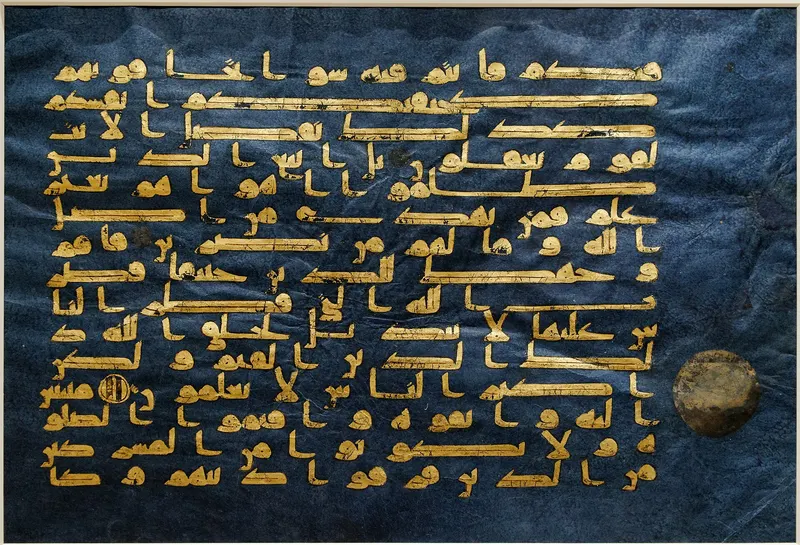
The history of the Quran, the holy book of Islam, is the timeline ranging from the inception of the Quran during the lifetime of Muhammad (believed to have received the Quran through revelation between 610 and 632 CE), to the emergence, transmission, and canonization of its written copies. In Sunni tradition, it is believed that the first caliph Abu Bakr ordered Zayd ibn Thabit to compile the written Quran, relying upon both textual fragments and the memories of those who had memorized it during Muhammad's lifetime, with the rasm (undotted Arabic text) being officially canonized under the third caliph Uthman ibn Affan (r. 644–656 CE), leading the Quran as it exists today to be known as the Uthmanic codex. Some Shia Muslims believe that the fourth caliph Ali ibn Abi Talib was the first to compile the Quran shortly after Muhammad died. The history of the Quran is a major focus in the field of Quranic studies.
In the 1970s, historians in the field of Islamic origins began to question Islamic "literary sources" tafsir, (i.e. commentaries on the Quran), hadith, (i.e. the accounts of what the Islamic prophet Muhammad approved of or did not), and sira, (i.e. the biography of the prophet) – upon which the traditional account of the Quran were based. They employed a "source-critical" approach to this literature, including as evidence relevant archaeology, epigraphy, numismatics, and contemporary non-Arabic literature, that they argued provided "hard facts" and an ability to crosscheck. There have also been a number of proposals for refinement of the traditional view and even its fundamental re-evaluation.
While traditional accounts may trace the canonization process of the Quran back to Uthman —or, in some cases, even to Abu Bakr or Muhammad himself— some Western scholars believe that this process continued over the course of several centuries, lasting until the rise of the Abbasids. Although The canonization process is believed to have been highly conservative, some amount of textual evolution is also indicated by the existence of codices like the Sanaa manuscript. Beyond this, a group of researchers explores the irregularities and repetitions in the Quranic text in a way that refutes the traditional claim that it was preserved by memorization alongside writing. According to them, an oral period shaped the Quran as a text and order, and mentioned repetitions and irregularities were remnants of this period.
The modern Qur'an contains numerous commands ("ql" meaning "say") which give it the image of a divine word addressed directly to Muhammad. Michael Cook offers an explanation of this phenomenon by examining the historical development of the Arabic writing system; in the original texts there was no distinction between "say" or "he said". However, later texts standardized the expression "ql" (which can be read as both "he said" and "say") in these texts to be read as "say" in many places.
Etymology
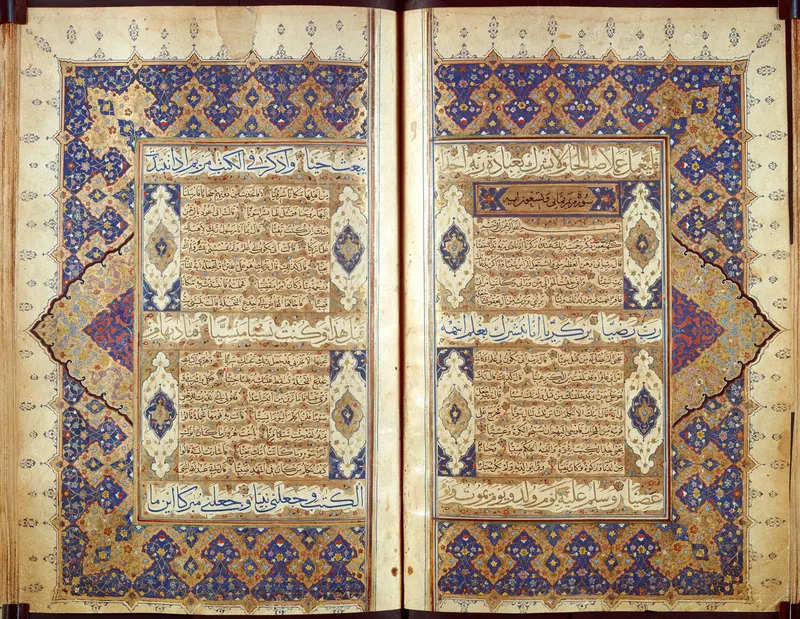
While there are various proposed etymologies, one is that the word 'Quran' (قرآن) comes from the Arabic verb qaraʾa (قرء, 'to read') in the verbal noun pattern fuʿlān (فعلان), thus resulting in the meaning 'reading' or 'reading book'. Nine out of the ten imams of recitation have it read in their tradition with a hamza, as Qur'ān (قرآن), with only Ibn Kathir's tradition excluding the letter, reading it instead as Qurān (قران).
Traditional history of the Quran
According to the Islamic tradition, the revelation of the Quran to the Islamic prophet Muhammad began in 610 CE when the angel Gabriel (believed to have been sent by God) appeared to Muhammad (a trader in the Western Arabian city of Mecca, which had become a sanctuary for pagan deities and an important trading center) in the cave of Hira. The revelations started one night during the month of Ramadan in 610 CE, when Muhammad, at the age of forty, received the first visit from the angel Gabriel, reciting to him the first verses of Surah Al-Alaq. Muslims believe that Muhammad continued to have revelations until his death in 632 CE. The Quran uses the term ummi (أُمِّيّ) to describe Muhammad. The majority of Muslim scholars interpret this word as a reference to an illiterate individual, though some modern scholars instead interpret it as a reference to those who belong to a community without a scripture.
The Quran emphasizes that Muhammad was required only to receive the sacred text and that he had no authority to change it. After Muhammad would receive revelations, he would later recite it to his Companions, who also memorized it or wrote it down. The practice of memorizing the whole Quran is still practised among Muslims. In the context of 7th-century Arabia, people had a penchant for recited poetry and competitions that featured the recitation of elaborate poetry were of great interest.
In Pre-Islamic Arabia, the society during the time of Muhammad was predominantly oral, and it is unknown whether the Quran was ever written and collected during the time of Muhammad. While writing was not a common skill during Muhammad's time, Mecca, being a commercial center, had a number of people who could write. Some scholars believe that several scribes including Zayd ibn Thabit and Ubay ibn Ka'b recorded verses of the Quran. This provides an explanation as to how the Quran existed in written form during the life of Muhammad, even if it was not compiled into one text. (See: Oral-formulaic composition)
Another story attributed to Ibn Abbas is this; "the prophet recited the book before Gabriel every year in the month of Ramadan, and in the month in which he died he recited it before him twice." The term 'recite', which is used here, is referring to the custom where a Quranic scholar recites the entire Quran from beginning to end a number of times before a senior scholar. According to this tradition the act of recital is being performed by Muhammad, with the angel Gabriel playing the role of superior authority. In one of the hadith Muhammad is recorded as saying: "I leave among you two things of high estimation: the Book of God and my Family." Some scholars argue that this provides evidence that the Quran had been collected and written during this time because it is not correct to call something al-kitab (book) when it is merely in the [people's] memories. The word al-kitab signifies a single and united entity and does not apply to a text which is scattered and not collected. However, Alan Jones has explored the use of this word in the Quran, finding that there is no evidence that it was used in such a "concrete sense" in reference to the Quran and other scriptures, but instead evidence points to an "abstract meaning". It can be accepted that the compilation of existing written material cannot be considered a complete text due to the expectation of additional revelation during Muhammad's lifetime, as well as Naskh accepted of by some scholars.
Abu Bakr
According to Sunni scholars, during the life of Muhammad parts of the Quran, though written, were scattered among his companions, much of it as private possession. According to Islamic sources after the Battle of Yamama in 633, when 70 Muslims who had memorized the Quran were killed, steps began to be taken to collate the body of material. The death of Salim Mawla Abi Hudhayfa was most significant, as he was one of the very few who had been entrusted by Muhammad to teach the Quran. Consequently, upon Umar's insistence, Abu Bakr ordered the collection of the hitherto scattered pieces of the Quran into one copy, assigning Zayd ibn Thabit, Muhammad's primary scribe, to gather the written fragments held by different members of the community. Ibn Thabit noted: "So I started looking for the Holy quran and collected it from (what was written on) palm-leaf stalks, thin white stones, and also from men who knew it by heart, until I found the last verse of Surat at-Tauba (repentance) with Abi Khuzaima al-Ansari, and I did not find it with anybody other than him.
Ibn Hajar al-Asqalani draws special attention to Zayd's statement, "I found two verses of Sura al-Bara'a with Abu Khuzaima al-Ansari," as demonstrating that Zayd's own writings and memorization were not deemed sufficient. Everything required verification. The compilation was kept by the Caliph Abu Bakr, after his death by his successor, Caliph Umar, who on his deathbed gave them to Hafsa bint Umar, his daughter and one of Muhammad's widows.
References
Text adapted from History of the Quran on Wikipedia (revision 1387330148), licensed CC BY-SA 4.0.