The Sana'a Manuscript
From Wikipedia: Sanaa manuscript
From the Deenlume library, adapted from Wikipedia
Awaiting review by a scholar. Please read with care and check the sources.
The Sanaa palimpsest (also Ṣanʽā’ 1 or DAM 01-27.1) or Sanaa Quran is one of the oldest Quranic manuscripts in existence and is important for textual criticism in Quranic studies. Part of a sizable cache of Quranic and non-Quranic fragments discovered in Yemen during a 1972 restoration of the Great Mosque of Sanaa, the manuscript was identified as a palimpsest Quran in 1981 as it is written on parchment and comprises two layers of text.
The manuscript leaves represent more than 40% of a complete Quran codex and have opened new horizons in the study of the Quran and ignited numerous theological debates. The upper text of the palimpsest should not be viewed as a version derived from minor corrections to the lower text; rather, it represents a complete erasure of the underlying text, followed by a rewriting of the Quran according to a newly adopted arrangement and content. In contrast to the radical differences found in the lower layer, the upper layer of the Sana’a palimpsest —the text written over the erased original— bears a large resemblance to the Quranic text known as Uthmanic mushaf today. A detailed study in 2021 on the physical aspects of the manuscript and its folios, show evidence that the Sanaa manuscript was once a different Quran than the Uthmanic text used today and the arrangement of the sheets show that the manuscript was used by two different experienced and professional scribes.
A partial reconstruction of the lower text was published in 2012, and a reconstruction of the legible portions of both lower and upper texts of the 38 folios in the Sana'a House of Manuscripts was published in 2017 utilising post-processed digital images of the lower text. A radiocarbon analysis has dated the parchment of one of the detached leaves sold at auction, and hence its lower text, to between 578 AD (44 BH) and 669 AD (49 AH) with a 95% accuracy. The earliest leaves have been tested at three laboratories and dated to 388–535 AD. Other folios have similar early dates. The generally accepted chronological framework within the academic community—based on the work of experts such as Behnam Sadeghi, Uwe Bergmann, Asma Hilali, and others—establishes the following:
Lower Text (Scriptio Inferior): The radiocarbon (C14) dating of the parchment, combined with the Hijazi script used in the underlying text —a style of early pre-Abbasid Arabic script that was in use and widespread well beyond the Hijaz region— reveals that this layer belongs to a pluralistic, pre-standardization era, contrary to what the script style itself might otherwise suggest.
Upper Text (Scriptio Superior): The script style, decorative features, and paleographic evidence of the upper text indicate that it was written during the Umayyad period —specifically between the late 7th and early 8th centuries —a time when Abd al-Malik ibn Marwan and his governor of Iraq, Hajjaj ibn Yusuf al-Thaqafi, established a rigid state standard for the Quranic codices and text, effectively enforcing uniformity.
Discovery
In 1972, construction workers renovating a wall in the attic of the Great Mosque of Sanaa in the Yemen Arab Republic came across large quantities of old manuscripts and parchments, many of which were deteriorated. Not realizing their significance, the workers gathered up the documents, packed them away into some twenty potato sacks, and left them on the staircase of one of the mosque's minarets.
Isma'il al-Akwa' bin Ali, then the president of the Yemeni Antiquities Authority, realized the potential importance of the find. Al-Akwa' sought international assistance in examining and preserving the fragments, and in 1979 managed to interest a visiting German scholar, who in turn persuaded the West German government to organize and fund a restoration project. The preserved fragments comprise Quranic and non-Quranic material.
Restoration project
Restoration of the fragments began in 1980 under the supervision of the Yemeni Department for Antiquities. It was funded by the Cultural Section of the German Foreign Ministry. The find includes 12,000 Quranic parchment fragments. All of them, except 1500–2000 fragments, were assigned to 926 distinct Quranic manuscripts as of 1997. None is complete and many contain only a few folios apiece. Albrecht Noth (University of Hamburg) was the director of the project. Work began in 1981 and continued through the end of 1989, when the project terminated with the end of funding. Gerd R. Puin (University of Saarland) was the director beginning with 1981. His involvement came to an end in 1985, when Hans-Caspar Graf von Bothmer (University of Saarland) took over as the local director. Bothmer left Ṣan'ā' in the following year, but continued to run the project from Germany, traveling to the site almost every year.
Beginning in 1982, Ursula Dreibholz served as the conservator for this project, and worked full-time in Ṣan'ā' until the end of 1989. She completed the restoration of the manuscripts. She also designed the permanent storage, collated many parchment fragments to identify distinct Quranic manuscripts, and directed the Yemeni staff in the same task. The manuscripts are located in the House of Manuscripts, the Dār al-Makhṭūṭāt (DAM), in Ṣan'ā', Yemen. After 1989, Bothmer would visit the collection periodically. In the winter of 1996–97, he microfilmed all of the parchment fragments that have been assigned to distinct Quranic manuscripts. Of the remaining 1500–2000 fragments, he microfilmed a group of 280. The microfilms are available in Ṣan'ā' in the House of Manuscripts. A selection of 651 images of fragments from the Sana'a cache - including several from DAM 01-27.1, has been issued on a CD-ROM through the UNESCO Memory of the World programme.
The Sana'a Palimpsest was given the catalog number DAM 01-27.1, indicating a manuscript with variable lines to the page (hence '01'), written line length of approx. 27 cm (11"), and with a sequence indicator of '1'. By 2015 some 38 folio fragments had been identified as likely to belong to this particular manuscript. From 2007, a joint Italian-French team under Sergio Noja Noseda and Christian Robin undertook to produce new high-resolution digital images of DAM 01-27.1 (and other selected manuscripts in the cache), under both natural and ultra-violet light, which have since been subject to extensive computerised post-processing by Alba Fedeli to separate upper from lower texts. The high resolution images form the basis for the editions of both Sadeghi and Goudarzi, and of Asma Hilali.
Contents of the manuscript
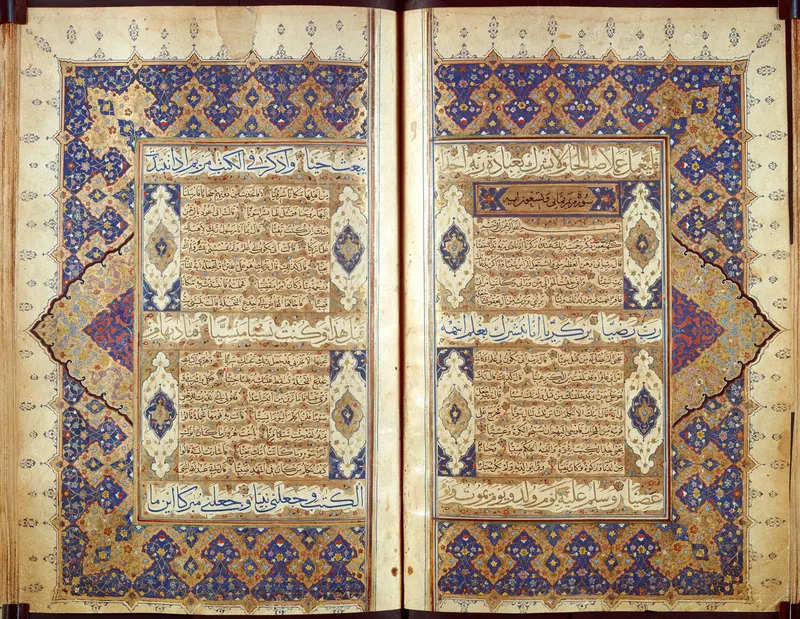
A manuscript is a palimpsest —that is, it is written on parchment that has been used before, with the original text erased to make way for new writing; this process can potentially be repeated many times. In the Sana'a palimpsest, both the upper and the lower text are the Quran written in the Hijazi script. While the upper text—despite some lacunae—largely corresponds to the standard, modern-day Quran, Éléonore Cellard argues in her codicological reconstruction that the lower layer—which has been the subject of intense academic debate—actually constitutes a coherent text that reflects the understanding of the Quran as it existed at that time, notwithstanding its non-standard arrangement. In the standard Quran, the chapters (surahs) are presented in an approximate sequence of decreasing length; hence a fragmentary Quran that follows the standard order of suras can generally be assumed to have once presented the complete text, but the contrary is not the case. Cellard's reconstruction has found that despite differences of sura sequence, the lower text too follows this same principle.
The manuscript that was discovered, however, is not complete. About 82 folios have been identified as possible sheets presenting the upper text, of which 38 are in Yemen's Dār al-Makhṭūṭāt (House of Manuscripts) and 4 in private collections (after being auctioned abroad). In addition in 2012, 40 palimpsest folios conserved in the Eastern Library of the Grand Mosque in Sana’a and published in 2004, were recognised as likely being detached folios of the upper text of DAM 01-27.1. Many of the folios in the House of Manuscripts are physically incomplete and in only 28 is the upper writing legible (due to damage), whereas those in private possession or held by the Eastern Library are generally in a better condition. These 82 folios comprise roughly half of the Quran. The parchment is of inferior quality, with many folios having holes around which both upper and lower text have been written. However, when the scale of the writing and the provision of marginal spaces is taken into account, the overall quantity of animal hides implied as being committed to the production of a full manuscript of the Quran would not have been less than for such high quality Qurans as the Codex Parisino-petropolitanus (BNF Arabe 328(ab)).
Historian Michael Cook sums up preliminary work on the Sana'a fragments as of 2000 thusly:
First, the range of variants is said to be considerably greater than is attested in our literary sources, though in character the variation does not appear to be very different from the kind of thing these sources record.
Second, the orthography of these – and other – early fragments diverges from that with which we are familiar in one rather striking respect, namely the frequent failure to mark the long ā as part of the consonantal skeleton in such words as qāla, 'he said' (the spelling ql which appears in these fragments would in our text be read as qul, meaning 'say!').
Last but not least, those fragments which show the end of one Sūra and the beginning of another reveal some clear deviations from the standard order of the Sūras; these deviations are comparable to those reported by the literary sources for a couple of the versions superseded by the ʿUthmānic codex, but they do not regularly coincide with them.
References
Text adapted from Sanaa manuscript on Wikipedia (revision 1386435649), licensed CC BY-SA 4.0.