Maryam bint Imran
Mother of Isa, honoured in the Quran for her devotion.
From the Deenlume library, adapted from Wikipedia
Awaiting review by a scholar. Please read with care and check the sources.
Maryam bint Imran (Arabic: مريم بنت عمران, lit. 'Mary, daughter of Imran') holds a singularly exalted place in Islam. The Quran refers to her seventy times and explicitly identifies her as the greatest woman to have ever lived. Moreover, she is the only woman referenced by name in the Quran. In the Quran, her story is related in three Meccan surahs (19, 21, 23) and four Medinan surahs (3, 4, 5, 66). The nineteenth Surah, Maryam, is named after her. According to the Quran, Mary's parents had been praying for a child. Their request was eventually accepted by God, and Mary's mother became pregnant. Her father Imran had died before the child was born. After her birth, she was taken care of by her maternal uncle Zechariah, a priest in the Temple. According to the Quran, Mary received messages from God through the archangel Gabriel. God informed Mary that she had miraculously conceived a child through the intervention of the divine spirit, though she was still a virgin. The name of her child, Jesus, was chosen by God—he was to be the Christ, the Promised Messiah in Islam. As such, orthodox Islamic belief has upheld the virgin birth of Jesus, and although the classical Islamic thinkers never dwelt on the question of the perpetual virginity of Mary, it was generally agreed in traditional Islam that Mary remained a virgin throughout her life, with the Quran's mention of Mary's purification “from the touch of men” implying perpetual virginity in the minds of many of the most prominent Islamic fathers. Mary is believed to have been chosen by God, above all "the women of the worlds" in Islam and is considered as one of the four "ladies of heaven" alongside Fatima, Asiya, the wife of the Pharaoh, and Khadija, the first wife of Muhammad. Modern scholarship often treats Christian apocryphal traditions mainly extant in the Gospel of James, and a later reworking of the same text called the Gospel of Pseudo-Matthew, as intertexts of the Quranic account of Mary's life.
Family
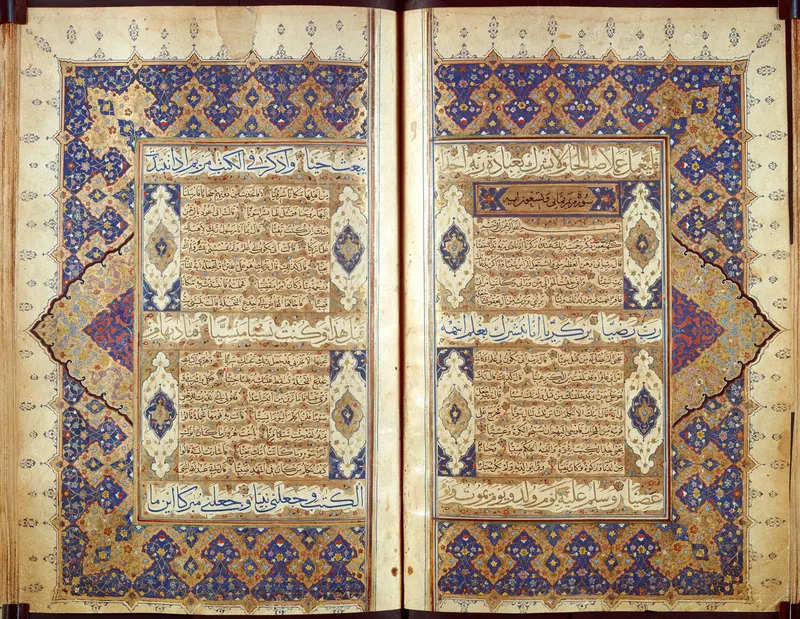
The Quran calls Mary, Arabic: مريم إبنت عمران, romanized: Maryam ibnat ʿImrān, lit. 'Mary daughter of Imran', not to be confused with Arabic: عمران, romanized: ʿImrān, lit. 'Amram' , the father of Miriam and Moses. It also mentions that people called her Arabic: أخت هـٰرون, romanized: Ukht Hārūn, lit. 'Sister of Aaron', not to be confused with Arabic: هـٰرون, romanized: Hārūn, lit. 'Aaron', the brother of Moses and Miriam. Her mother, mentioned in the Quran only as the wife of Imran, prayed for a child and eventually conceived. According to al-Tabari, Mary's mother was named Arabic: حنة, romanized: Ḥanna, lit. 'Anne' and her husband died before the child was born. Expecting the child to be male, Anne vowed to dedicate him to isolation and service in the Temple. However, Anne bore a daughter instead, and named her Mary.
In the Quran
Mary is mentioned frequently in the Quran, and her narrative occurs consistently from the earliest chapters, revealed in Mecca, to the latest verses, revealed in Medina.
Birth
The birth of Mary is narrated in the Quran with references to her father as well as her mother. Mary's father is called ʿImrān in Arabic. Her mother, according to al-Tabari, is called Anne, which is the same name as in the Gospel of James. Muslim literature narrates that Imran and his wife were old and childless and that, one day, the sight of a bird in a tree feeding her young aroused Anne's desire for a child. She prayed to God to fulfill her desire and vowed, if her prayer was accepted, that her child would be dedicated to the service of God.
E.H. Palmer, in his late 19th-century translation of the Quran, included in the Sacred Books of the East series, noted that: Amram; who, according to the Mohammedans, was the father of the Virgin Mary, (Miriam.) A confusion seems to have existed in the mind of Mohammed between Miriam 'the Virgin Mary,' and Miriam the sister of Moses. This view was further corroborated in the 20th century. According to N.J. Dawood, the Quran confuses Mary, mother of Jesus with Miriam, sister of Moses, when it refers to the father of Mary as Imran, which is the Arabic version of Amram, who is shown to be the father of Moses in Exodus 6:20. Dawood, in a note to Quran 19:28, where Mary is referred to as the "Sister of Aaron", and Aaron was the brother of Miriam, states: "It appears that Miriam, Aaron's sister, and Maryam (Mary), mother of Jesus, were according to the Koran, one and the same person." In the 21st century this view remains common in Islamic studies, for example in Gabriel Said Reynolds' work.
More recent scholarship by Angelika Neuwirth has argued that far from a genealogical mistake, the Quranic account is to be understood two-fold, first as a Meccan telling (Surat al-Maryam) and later a politicized Medinan retelling (Surat al-Imran) of the same account—in its second form being a theological response to Christian objections to the initial Quranic account by incorporating polysemy found in Medinian Judaism. In her view the accounts draw on Christian traditions preserved in Byzantine hymns as sources. The complexities navigated by the accounts are mainly related to the patriarchal authority of the House of Abraham and the Quran's apocryphal adoption of the possibly competing House of Imran defined by its female members, as well as an adoption of a general concept of the Holy Family. The ultimate solution of the retelling process was an account which allowed prophetic revelation surrounding motherhood and scripture—which the Christian tradition attributes to Mary—to be recast as Arabic: أمّ الکتاب, romanized: Umm al-Kitab, lit. 'Mother of Scripture' originating with Muhammad, with the Abrahamic prophetic lineage also being moved from the Holy Family to Muhammad himself. Michael Marx further builds on this analysis and identifies the Quranic account as a retelling of Mary as the Temple from the Christian tradition as Mary in the Temple. Thus, in an attempt to eliminate the allegorical prerogatives of the Christian story to avoid the conclusion of a deified Christ, only traces of pre-Islamic Mariology remain in the text. Such a purposeful deviation from Christian accounts is further supported by Wensinck's argument regarding the figurative speech of the Quran and the Islamic tradition: Maryam is called a sister of Hārūn and the use of these three names Imrān, Hārūn and Maryam, has led to the supposition that the Kur'ān does not clearly distinguish between the two Maryams of the Old and the New Testaments. It is not necessary to assume that these kinship links are to be interpreted in modern terms. The words "sister" and "daughter", like their male counterparts, in Arabic usage can indicate extended kinship, descendance or spiritual affinity. Muslim tradition is clear that there are eighteen centuries between the Biblical Amram and the father of Maryam. Similarly, Stowasser concludes that "to confuse Mary the mother of Jesus with Mary the sister of Moses and Aaron in the Torah is completely wrong and in contradiction to the sound Hadith and the Quranic text as we have established". Despite likely being familiar with narrative traditions represented in the Gospel of James, the Quranic account of Mary's birth does not affirm the Immaculate Conception.
References
Text adapted from Mary in Islam on Wikipedia (revision 1383794062), licensed CC BY-SA 4.0.